
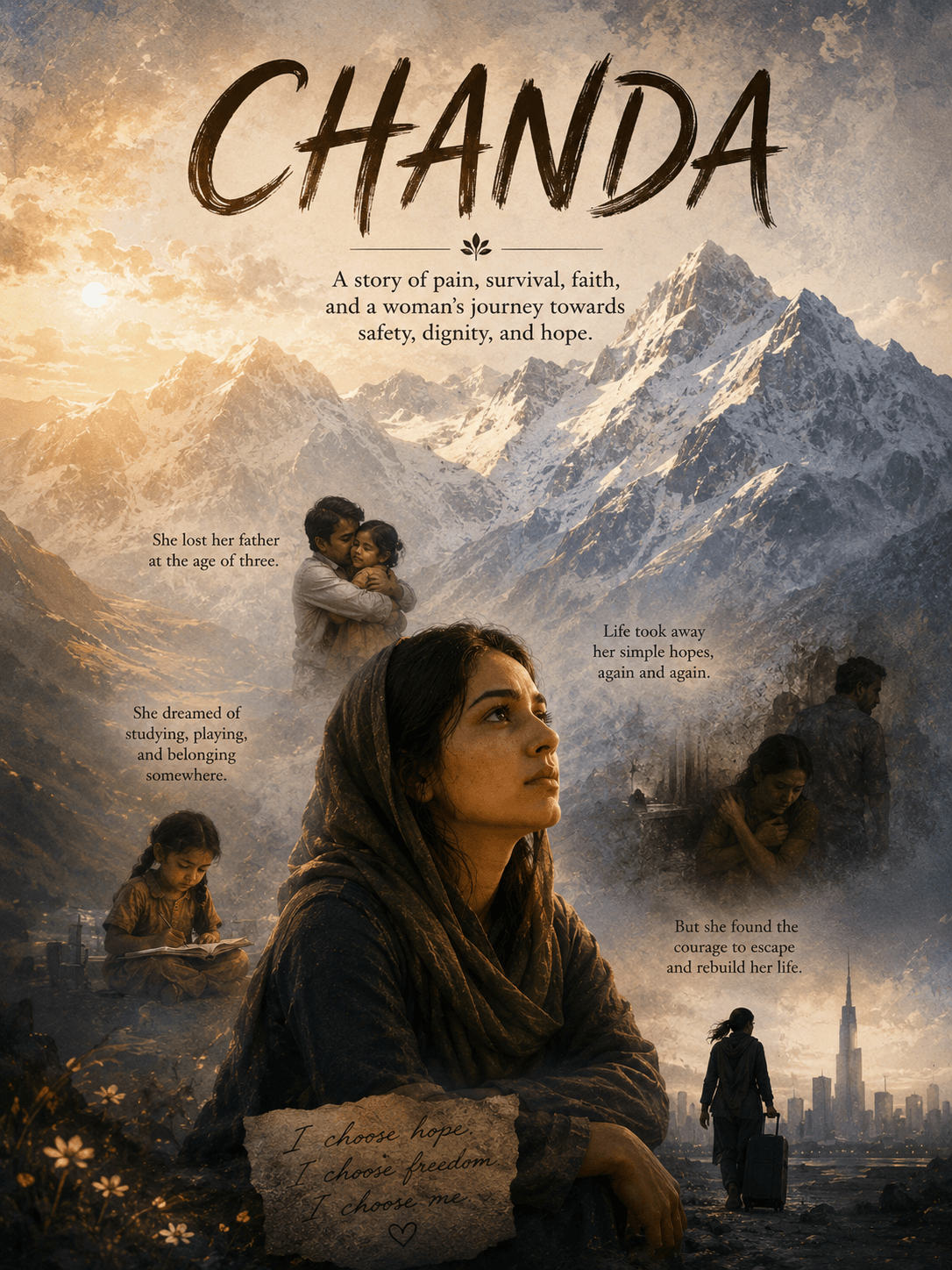
Chapter 2 - A Journey into the Mountains
Select a passage to comment on it
Not long after Chanda’s father died, her mother made a decision that would change both of their lives.
They could no longer remain where they were.
The house that had once felt safe had become filled with memories, whispers, and uncertainty. Every corner reminded Chanda’s mother of the man she had lost. Every visit from relatives brought new advice, new criticism, and new questions about how she would survive alone with a small child.
Some people spoke kindly.
Others spoke as though her life now belonged to them.
“You cannot manage everything by yourself.”
“You should go and live with your relatives.”
“A young widow should not stay alone.”
The words were presented as concern, but they felt like walls slowly closing around her.
Chanda’s mother had very little money and almost no freedom to choose what came next. She knew that staying would mean depending on people who watched her every movement and judged every decision she made.
So, one morning before sunrise, she packed their few belongings.
There was no large suitcase.
Only a worn cloth bag filled with a few dresses, a shawl, some basic utensils, and the small items she could not bear to leave behind.
Among them was one of Chanda’s father’s old handkerchiefs.
Her mother folded it carefully and placed it at the bottom of the bag.
Chanda stood nearby, holding a broken wooden toy in one hand.
“Where are we going, Ammi?” she asked.
Her mother looked at her and forced a smile.
“To the mountains.”
“Will Baba be there?”
The question struck her mother like a sudden wound.
She lowered her eyes.
“No, my child,” she said softly. “But perhaps we will find some peace there.”
Chanda did not understand what peace meant.
She imagined it was a place.
Perhaps a house with a bright blue door.
Perhaps a garden where no one cried.
Perhaps a village where fathers returned.
They left quietly.
The streets were still dark, and the morning air was cold. Chanda held her mother’s hand as they walked towards the bus station.
The cloth bag rested heavily on her mother’s shoulder.
Chanda’s mother did not look back.
She feared that if she did, she might lose the courage to leave.
The bus was crowded when they arrived. People pushed past one another, carrying bundles, baskets, blankets, and children.
The air smelled of dust, fuel, and sweat.
Chanda’s mother climbed aboard carefully and found a narrow seat beside the window. She placed Chanda on her lap and held the bag between her feet.
The engine started with a deep, rough sound.
Chanda pressed her face against the glass.
As the bus moved, the place she had known all her short life began to disappear behind them.
The familiar streets became smaller.
The houses blurred into the distance.
The road stretched forward into a world Chanda had never seen.
At first, she was excited.
She watched carts, animals, roadside shops, and people walking beside the road. She pointed at everything and asked questions faster than her mother could answer.
“What is that?”
“Where is he going?”
“Why is that goat standing there?”
“Will the mountains be very big?”
Her mother answered when she could, though her mind was elsewhere.
She was thinking about money.
About where they would stay.
About whether her relatives would welcome them.
About whether she had made the right decision.
She was also thinking about the future she wanted for Chanda.
A safe home.
A proper education.
Enough food.
A childhood without fear.
They were simple dreams, but even simple dreams felt expensive.
As the journey continued, the landscape slowly changed.
The dry plains gave way to rocky roads.
The air became cooler.
The hills rose higher on both sides, and the road began twisting through narrow passes.
Chanda’s excitement faded into silence.
She stared at the mountains with wide eyes.
They seemed endless.
Their shadows covered the road, and their peaks disappeared into the clouds.
To Chanda, they looked like enormous walls guarding a hidden world.
She pressed her hand against the window.
“Do people live up there?” she asked.
“Yes,” her mother replied.
“Are they happy?”
Her mother looked towards the mountains.
“I hope so.”
The bus shook violently as it crossed rough stretches of road. Passengers held onto the seats, and luggage shifted above their heads.
At one point, the bus stopped beside a narrow roadside shelter. People stepped outside to stretch their legs and drink tea.
Chanda’s mother bought only one small piece of bread.
She broke it in half and gave the larger portion to Chanda.
“Aren’t you hungry?” Chanda asked.
“I already ate,” her mother lied.
Chanda believed her.
She ate slowly, looking at the snow-covered peaks in the distance.
The mountains looked beautiful, but her mother saw something else.
Distance.
Isolation.
Uncertainty.
By evening, the cold had grown stronger.
Chanda curled against her mother’s chest beneath the shawl. The bus continued climbing through darkness, its headlights cutting across the road.
Inside, most passengers had fallen asleep.
Chanda’s mother remained awake.
She held her daughter tightly, listening to the engine and the sound of stones beneath the tyres.
Every sudden turn frightened her.
Every steep edge reminded her how little control she had over their lives.
Chanda stirred in her sleep.
“Ammi,” she whispered.
“I am here.”
“Don’t leave me.”
Her mother kissed the top of her head.
“I will not leave you.”
It was a promise made with love.
It was also a promise life would later make difficult to keep.
The next morning, the bus entered a quiet valley surrounded by towering mountains.
Small houses stood close together beneath the pale morning sky. Thin smoke rose from chimneys, and narrow paths wound between stone walls and fields.
The valley was beautiful.
There were streams of clear water, orchards hidden behind walls, and snow shining on distant peaks.
For a moment, Chanda forgot her tiredness.
She sat upright and stared outside.
“Is this our new home?”
Her mother looked at the valley.
She wanted to say yes.
She wanted to believe they had finally reached a place where no one would trouble them.
But she did not know which house would accept them.
She did not know how long they would be allowed to stay.
She did not know that Chanda would soon begin moving from one relative’s home to another.
So she simply said, “This is where our family lives.”
A man was waiting for them near the road.
He was one of Chanda’s maternal uncles.
He greeted them briefly and lifted the cloth bag from the bus.
Chanda looked at him, then at her mother.
“Is this our house?” she asked again.
Her mother hesitated.
“For now,” she replied.
Those two words would define much of Chanda’s childhood.
For now.
This room was hers—for now.
This bed was hers—for now.
This family welcomed her—for now.
Nothing felt permanent.
Nothing truly belonged to her.
They walked through the narrow lanes towards her uncle’s house.
Women looked out from doorways.
Children paused their games to stare at the newcomers.
Chanda held her mother’s hand tightly.
She wanted to smile at the children, but none of them smiled back.
At the house, Chanda’s aunt greeted them politely, though her eyes immediately moved towards the small bag.
“You brought only this?”
Chanda’s mother nodded.
“This is all we have.”
Her aunt stepped aside and allowed them to enter.
The room they were given was small and cold. It contained a thin mattress, an old blanket, and a wooden chest.
There were no toys.
No pictures.
No space that belonged to Chanda.
Still, her mother placed the cloth bag near the wall and tried to make the room feel welcoming.
“Look,” she said, opening the small window. “You can see the mountains.”
Chanda climbed onto the mattress and looked outside.
The mountains stood in silence, huge and distant.
That night, she lay beside her mother beneath the old blanket.
The house was filled with unfamiliar sounds.
Footsteps in the hallway.
Whispering from another room.
The clatter of dishes.
A baby crying somewhere nearby.
Chanda closed her eyes, but sleep did not come.
“Ammi?”
“Yes?”
“Are we staying here forever?”
Her mother remained silent for a moment.
Then she reached for Chanda’s hand.
“We are safe tonight,” she said.
It was not an answer.
But it was the only promise she could make.
Outside, the mountain wind moved through the valley.
Inside, Chanda held her mother’s hand and tried to believe that this unfamiliar house could become a home.
She did not yet know that it was only the first of many.